Friday, 16 March 2018

VANCE JOY - RIPTIDE

POSTMODERNISM 
cannot be defined, shouldn't be a theory

  • 'style of substance' - valuing the looks of something over the depth of it
  • emphasises surface meaning over deeper analysis - shouldn't be analysed
  • distrust of form and established conventions - break rules on purpose 
  • e.g. 'breaking the fourth wall' - character turning to talk to the audience in a film
VANCE JOY - RIPTIDE (2013)
https://www.youtube.com/watch?v=uJ_1HMAGb4k

Vance Joy is an Australian singer-songwriter signed to Atlantic Records (subsidiary of major label, Warner). His music can be categorised as fitting into indie folk-pop genre. Riptide was Vance Joy's first single to be released in the USA, it became a platinum selling single. The video was directed by Dimitri Basil and Laura Gorun and has had nearly 210 million youtube views

OBJECTIFICATION  the process by which a human is represented as an object
MALE GAZE  the assumption that every media product is created for the heterosexual male audience, therefore, the function of any woman we see is for their pleasure, Lizbet Van Zoonen
SEXUALISATION  the process of only valuing someone for their sexual appeal
VOYEURISM  taking pleasure of watching someone whilst they're undetected 
SCOPOPHILLIA  the love of watching (voyeurism)
  • general theme and narrative - montage of shots suggests themes of drowning and death ("sank", makeup coming off, "lump in my throat")
  • alternative theme and narrative - unpredictable and deliberately misleading montage of shots
  • deliberately invites polysemic interpretations 
  • montage consistently matches the themes of the lyrics - "cowboy running" in a long, cantered shot, symbolic of dual personality, afraid of what he has become
  • intertextuality of old western film - mise en scene of costume, referential code to create audience appeal
  • intertextuality of horror film - mid shot of ouija board, "dark side", referential of 70's horror cinema
  • date on letter is "August 1974" - mid shot, anchors audience into a particular time period, picked 70's because it was considered cool 
  • mid shot of feet being dragged under a bed, low angle shot, low-key purple lighting- purple lighting connotes evil and darkness, specific reference to 1970's Italian horror films
  • denies the audience of a definite meaning
  • voyeuristic, high angle long shot of young, blonde woman removing swimsuit, zooms in - high angle shot is demeaning towards woman because we look down on her, makes reference to lyrics "pretty girls", voyeuristic aspect is creepy, positions audience to a perverted perspective, Van Zoonen's 'Female Gaze' theory
  • "techniques of photographing girls" - female, manicured hand pushes book into the centre of the frame, seems rehearsed and non-consensual

  • high angle shot - voyeuristic intent (positioning)
  • looking out into the ocean, symbolic of adventure 
  • mise en scene of costume - exotic 
  • framed in centre of shot - emphasizes her importance to heterosexual male audience (male gaze)
  • shallow depth of field shot - she is in focus, background is blurred, importance
  • shot with zoom lens - voyeuristic 
  • stereotypically attractive - blonde hair
  • mid shot of her back - implies she isn't aware that the audience is watching
  • mise en scene of beach - adventure, luxury 
Representation of women


  • women are vulnerable - stereotypical in films/ intertextuality, damsels in distress, voyeuristic angles 
  • powerful and independent - smoking, stereotypical of men
  • often close to men or being comforted by men - dependant 
  • various shots of feet and hands - objectify women, audience can't see their emotions 
  • subverts and conforms to stereotypical representations of women
  • no explicit anchorage of ideology in music video 
How does thus video to Riptide encode feminist ideology?
  • almost mocking sexism in music videos - book of "how to photograph girls", connotes that women are purely present to be looked at by male heterosexual audience 
  • mise en scene of masculine clothing 
  • low angle mid shot of woman holding arms in air - gesture connotes power
  • mid shot of blonde woman bound in tightrope - connotes the restrictions that females face in society, critical of the notion of woman as a 'weaker sex' , women are being 'tied down' with maternal responsibilities etc
  • video lacks anchorage - forces audience to make their own assumptions, highly polysemic
  • ironic representation of patriarchal hegemony 


'SUSPIRIA' (1979) re-release trailer
Italian horror film

Paradigmatic features
  • props - knives, noose, gloved hands, barbed wire
  • weak and vulnerable female protagonist - damsel in distress archetype
  • colour scheme - vibrant primary colours, red and blue filters, typical of 70's European horror
  • soundtrack - use of suspenseful non-diegetic sounds, diegetic female screaming
  • iconographic features such as cherry-red blood
The iconography in Riptide heavily references the horror genre ('dentist' looks like a torture device, dull and unsaturated colour, vibrant use of reds on lips and nails)

SURREALISM  an artistic movement that originated in France, a text which follows the logic of dreams

"Un Chien Andalou" - French surrealist film

"Riptide" and "Un Chien Andalou" both lack continuity (subversive of regular films and music videos that use eye-line matches and a match on action)

Surrealism allows a larger audience, gratification of intertextuality and social interaction (will go away and talk about it)




Thursday, 15 March 2018

MUSIC VIDEOS

  • video that accompanies a song
  • visual aspect of the song
  • often includes performance
  • another level of entertainment 
  • promotes the song
  • looks how a song sounds
POLYSEMY  multiple meaning
CULTURAL/SOCIAL CONTEXT  whats going on in the world at the time

Audience can identify the most with music over any other music product - personal
  • SCOPITONE  video jukebox - popular in France, beginning of music videos
France Gall - Baby Pop (1965)
https://www.youtube.com/watch?v=vczO-PqhDis
  • binary opposition between music video and lyrics - dancing in the video but lyrics translate as "alone and abandoned"
  • setting is unconventional and boring - (e.g. office and bleak building) , this architecture in 1960's was considered cool
  • long shot of her looking away from camera - awkward, first music videos
  • conventional costumes - chic and fashionable in 1960's
Rebecca - Vanity Angel (1989)
https://www.youtube.com/watch?gl=SN&hl=fr&v=EtdkgVMBbNQ
  • mid shot, looking into camera, direct mode of address - conventional , performance 
  • colourful and fast-paced editing - Japanese style music video
  • young woman, aspirational - targets audience of teenage girls
  • low angle shot of building with neon lights - lights make it exciting, stereotypical American apartment, exotic appeal for Japanese audience (escapism) 

Pulp - Babies (1994)
https://www.youtube.com/watch?v=38by00DGid0

  • the diegesis of sound is complicated  
  • use of text/ graphics/ inter title - communicates explicit meaning to the audience
  • long shot at the beginning introduces band - slowly coming into focus
  • mise en scene is typical of socio-political context - bedroom is working class (small), aiming for working class audience 
  • suit without a shirt and miserable-looking keyboard player - doesn't conform to hegemonic codes
CONVERGENCE  the 'coming together' of 2 previously separate media industries (film and music)

Why do music videos exists?
  • completely new
  • another way to earn money 
  • another form of entertainment - targets more audiences
  • a different way to listen to music
  • an advert for the song and artist
SYNGERGY  where the interconnectedness of media products leads to a result of more of the sum of its parts (the benefits of convergence) - easily shared

MTV - used to only play music videos, 1980's, music videos became really popular, American channel 

Music video Vs Cinema 

MV
  • beat matching 
  • shorter (average 3-4 minutes)
  • less elaborate narrative
  • no expectation of trailer
  • video isn't the product, it's the advert 
  • hyper-energetic 
  • fast-paced editing
  • a lot of direct address
  • younger target demographic
  • free
C
  • music is just played over the top
  • longer (average 1.5-2 hours)
  • elaborated narrative
  • expectation of trailer
  • the product
  • realistic, less energy 
  • slower- paced editing (other than action scenes)
  • less direct address 
  • older target demographic
  • expectation to pay
CELEBRITY  "the attribution of glamorous or notorious status to an individual in the public sphere"

Lady GaGa - Applause (2013)
https://www.youtube.com/watch?v=pco91kroVgQ
  • mid shot, mise en scene of eye mask - secrecy
  • lack of clothing symbolises boldness of personality - celebrity is encoded by breaking hegemonic rules of society
  • mise en scene of cauldron symbolises thats she's a witch - potentially a difficult and unpleasant person
  • long shot, audience's eyes go towards her even though she's in a group - key-light id shone on her
  • close up shot with highkey-lighting - importance 
  • mise en scene of large bouquet of flowers - polysemic meanings of funeral or a winner, funeral meaning symbolises she's making a comeback because the old her is 'dead'
  • binary opposition between revealing and covered up costumes - subversive of celebrities (making her a celeb)
  • consistent use of close-ups of her face - encodes she is a celebrity 
METANARRATIVE  (aka GRAND NARRATIVE) refers to an overarching narrative or system of beliefs that helps us to make sense of the world (e.g. religion, science, marriage, marxism)

Tuesday, 30 January 2018

key words

STEREOTYPICAL  relating to a widely held but fixed and oversimplified image or idea of a particular type of person or thing
CONFORMS  comply with rules, standards, or laws
SUBVERTS  undermine the power and authority of (an established system or institution)
OBJECTIFICATION  the action of degrading someone to the status of a mere object
SEXUALISATION  to make something sexual in character or quality
HEGEMONY leadership or dominance, especially by one state or social group over others
PATRIARCHAL HEGEMONY leadership or dominance, especially by one state or social group over others (men over women) 
CHALLENGES  a call to someone to participate in a competitive situation or fight to decide who is superior in terms of ability or strength
FETISHISATION  worship of an inanimate object for its supposed magical powers or because it is considered to be inhabited by a spirit
SYMBOLIC ANNIHILATION  the absence of representation, or underrepresentation, of some group of people in the media (often based on their race, sex, sexual orientation, socio-economic status, etc.)
SCOPOPHILIA/ VOYEURISM sexual pleasure derived chiefly from watching others when they are naked or engaged in sexual activity

Theorists

MEDIA LANGUAGE
  • Claude Levi-Strauss - Structuralism (Binary Opposition) 
  • Roland Barthes - Semiotics 
  • Tzvetan Todorov - Narratology (Equilibrium)
  • Steve Neale - Theories around Genre (Repetition and Difference)
REPRESENTATION
  • bell hooks - Feminism
  • David Gauntlet - Theories of Identity (Pick n Mix) 
  • Stuart Hall - Representation
  • Lisbet Van Zoonen - Feminist Theory (Male Gaze)
INDUSTRY
  • Sonia Livingstone and Peter Lunt - Regulation
  • Curran and Seaton - Power and Media Industries
  • David Hesmondhalgh - Cultural Industries
AUDIENCE
  • Albert Vandura - Media Effects (Hypodermic Needle)
  • Stuart Hall - Reception Theory (Readings)
  • George Gerbner - Cultivation Theory

Tuesday, 23 January 2018

ADBUSTERS

First impressions:
  • no idea what genre - every cover is different, doesn't include contents on the cover
  • parody
  • political
  • mainly central images
  • mastheads are all different - identity isn't consistent 
  • the magazine doesn't contain any paid-for adverts
Adbusters May/June 2016
  • published 6 times a year by Adbusters Media Foundation
  • £10.99
  • 120,000 readership (website April 2017)
  • independent/campaigning/culture jamming genre 
  • confusion is a good reaction
  • "post-west" - war of the west, America 
  • angry gesture and army jacket - anarchy, going against social norms of society
  • could look excited - we enjoy war, criticizing our culture
  • masthead covered in dirt and sand - destroying identity of magazine, focus on "post-west", vandalism, don't care what the audience thinks about them
  • subverts a lot of conventions of magazines - stands out as its own identity
  • front cover image isn't anchored with a caption - hermeneutic code, read it to find out
  • black background - subverts conventions of consumer/lifestyle magazines
  • male in camouflage jacket - not a model, not there for audience to aspire to be him, hermeneutic code 
  • front cover in not fully anchored - assumes a level of understanding from the audience
  • cover lacks conventions of magazines - what's inside?, genre?, designed to challenge you

"Genre conventions in magazines are completely informed by the social and historical context to which they are made" - Michael Collins
Evaluate this statement with reference to Adbusters. Make reference to genre hybridity 
  • genre conventions - things that make magazines and their genres
  • different historical and social contexts will affect the conventions of the magazines
  • global terrorism, Brexit, Donald Trump elected as president
  • evaluate 
How to structure an essay:
  1. Read the question and underline key terms
  2. Gut reaction - whats your opinion? what argument will you make?
  3. Plan - on the answer paper (social, historical, political ideologies, genre hybridity, financial reasons)
  4. Introduction - (context - Adbuters Media foundation, 1st published 1989)(definition - genre, why is it important?)(arguament - "In general, Collins.....")
  5. Paragraphs (point - a sentence or two, clarifies what the paragraph is about)(evidence - from a very specific source)(argument - theorists, analyse evidence)
  6. Conclusion - no new information - need your opinion to come through, repeat what you've already said

  • red logo against white draws attention
  • "red soles are always in season" - lexis refers to the high-end brand but also sore feet on the child ("red soles"), dark humour
  • binary opposition - brand against image, conventions of a charity advert
  • makes readers feel guilty because they're spending money on expensive shoes, whilst some children don't have any, dominant reading
  • lexis targeted towards middle class - more likely to own the shoes, even more guilt
  • pure white background is a binary opposite to the image of poverty
  • anti-consumerism ideology
  • wearing the shoes gives people cultural capital 


  • no language, no lexis, no anchorage
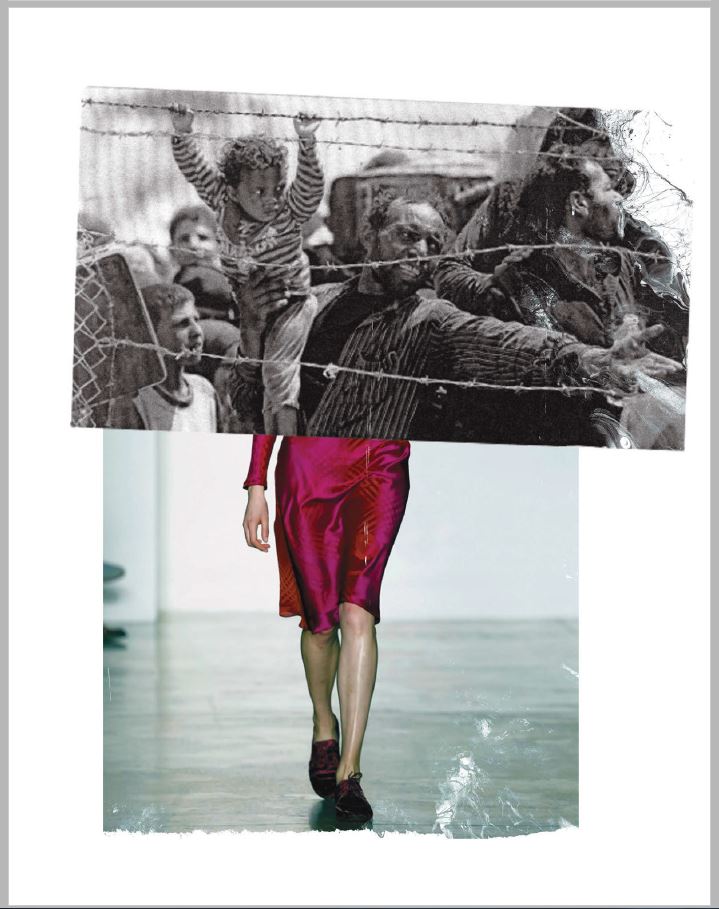
  • binary opposition of image of refugees trying to escape from somewhere (colour of skin, clothes, location, facial expressions) against catwalk (clothing, location)
  • we all live in the same world but everyone lives so differently, complete poverty vs absolute luxury 
  • sense of helplessness and confusion
  • monochrome and coloured image - emphasizes the difference 
  • consumerism fills a void that people feel when they see negative images of 3rd world suffering 
  • mid shot shows they're in a really small space together 


COMMODITY FETISHISM  giving a significant value to an object
MARXISM  conflict between the working class and ruling class
  • working class is exploited by ruling class
  • working class is kept poor, kept in their place
  • Adbusters have a very marxist ideology

  • dutch tilt - mystery, drama and romance
  • "him" - personification, 
  • white backgrounds - purity, cleanliness, elegance
  • model has tattoos - unconventional for women
  • tap has a lot of cultural capital - commodity fetishism
  • "poor people" - identified as poor, stating facts to reader
  • nothing to anchor the image - confusing, 2 readings, high angle shot with nothing in her hands shows weakness and vulnerability, hands wrinkly because she's had a bath, she's got enough water to have a bath
  • we should appreciate water 
  • binary opposition of the zucchetti tap - tap is the focus (fetish) 
  • water is being glamourised and turned into a product (commodified) 
  • you can almost see through the water - crystal clear compared to "pollution"

'The representation of women in Adbusters is consistently subversive'

I would agree that the representation of women in Abusters is consistently subversive because they are not sexualised for audience pleasure. For example, the magazine has included an image of a woman in a bath, yet only her hands, knees, and bottom of her face are shown. Traditionally, the chance to sexualise women in adverts is desirable because it broadens the target audience, especially heterosexual males; Lizbet Van Zoonen's feminist theory supports this, she also refers to this as the 'male gaze'. Therefore, this representation of the female model subverts stereotypes of magazines and adverts because she hasn't been displayed to attract an audience or to appeal to be desirable. 

The magazine also goes against hegemonic ideas of gender in the image of a female model on a catwalk, which has been covered by another image of refugees in a 3rd world country. This collage forms what Claude Levi-Strauss would call binary opposition, which is emphasized with the difference between colour and monochrome. The female legs connotate the fashion industry, however, the image is subverted because the audience is robbed of seeing her face. 


  • Representation is a way to manipulate the audience 
  • The dominant ideology of Adbusters is anti-capitalist, by attacking adverts and capitalism (marxist) 
  • "went head on against the whole fucking industry"
  • "totally dedicated to staying hard copy"
  • "We have this culture jammers network, and almost 100,000 people have signed up"
  • "there’s been a lot of out-of-the-box thinking, and a lot of young designers don’t wanna spend the rest of their lives kissing corporate ass"
  • "Adbusters talk a lot to the converted, but you have a whole bunch of interesting unconverted people so fuck it, convert them"

WEBSITE 

DIFFERENT HOUSE STYLE (FONTS)

REINFORCES BRAND IDENTITY
  • SOMETHING THEY DON'T OFFER IN THE MAGAZINE (ADVERT)
  • EXTENDS THE BRAND
SOCIAL MEDIA

INTERACTION WITH AUDIENCE


It is important for print magazines such as Adbusters to have an online presence because it opens it's potential target audience to younger adults/ teenagers. For example, the magazine publishers have expanded the brand onto various social media platforms, such as Instagram and Twitter, which are commonly used by younger people in their everyday lives; therefore, this increases the brand awareness. By posting examples of things that can be found in the magazine and on the website, this may increase interest and give new readers an idea of what they'll find in the magazine, which should increase sales. Additionally, it is much easier for younger teenagers to access the content of the magazine online because of the easy accessibility. Sonia Livingstone's Theory of Regulation suggests that because of the freedom that we have on the internet, it is much easier for regulations and restrictions to be bypassed, which makes the magazine even more available for this new audience. 

BUY NOTHING DAY
  • "buying stuff will never make you happy"
  • want their readers to buy nothing for a day

Thursday, 18 January 2018

MAGAZINE INDUSTRY

BRAND IDENTITY  how a business presents itself and how it wants to be perceived by its consumers (e.g logo - builds consumer's trust)

Comparing the brand identity of Woman (August 1964) and Vogue (July 1965);

  • Vogue cover emphasises regal connotations of blue/teal - model is superior to audience, high end 
  • Woman's model looks relatable and familiar to audience, accessible to everyone 
  • Vogue model looks intelligent and confident
  • Woman's smile looks naive - forced and passive
  • Vogue masthead is disguised - confident mode of address because producer doesn't care if it stands out, selling point is model on the cover, audience needs to know about fashion to appreciate the magazine
  • Woman's cover is white - stand out against model, producer wants the audience to see it, attract new readers
  • Vogue model is 31 - looks much more mature
  • Woman model is roughly 35 - childish smile
  • Vogue lexis is difficult to understand - "scintillate", restricted language, part of exclusive readership
  • Woman's lexis is easy to read - doesn't restrict audience 
  • Vogue contents is mysterious - established and confident brand identity
  • You know what you're going to get inside Woman magazine - "seven star improvements" - need to convince target audience to buy the magazine
IPC

Pinpointing exactly how far Time Inc. UK's (formerly IPC Media) roots stretch back into the midst of publishing history is a complicated business. The International Publishing Corporation Ltd was formed in 1963 following the merger of the UK's three leading magazine publishers - George Newnes, Odhams Press and Fleetway Publications - who came together with the Mirror Group to form the International Publishing Corporation (IPC). And IPC Magazines was created five years later, in 1968. But those three original magazine businesses each had their own illustrious history, having been established in 1881, 1890 and 1880 respectively, with a number of the titles they launched in the late 19th Century still being published today under the Time Inc. UK umbrella. And when The Field, launched in 1853, joined the IPC stable in 1994 following the acquisition of Harmsworth Magazines, it saw our family tree reach back even further. IPC was acquired by Time Warner in 2001 and was renamed Time Inc. UK in 2014 after Time Inc. acquired the company in connection with its spinoff from Time Warner.

  • Large mainstream organisation
  • Media conglomerate 
CURRAN AND SEATON
POWER AND MEDIA INDUSTRIES
  • media is controlled by a small number of companies, all driven by power and profit
  • media concentration limits variety, creativity and quality

Tuesday, 9 January 2018

WOMAN MAGAZINE 1964

  • Everything you study in component 2 will come up in the exam
  • You will get unseen texts in component 1
  • In component 2, you need to voice your opinion
  • You need to refer to the historical context of the magazines
  • You need to make up the question yourself (no definitive question means no definitive answer)
  • You don't need to give a balanced argument
ROLAND BARTHES SEMIOTICS 
REFERENTIAL, SYMBOLIC, PROAIRETIC, HERMENEUTIC 

CLAUDE LEVI STRAUSS STRUCTURALISM
BINARY OPPOSITION (WE SEE THE WORLD THROUGH WHAT IT ISN'T)

What makes a magazine a magazine?
  • glossy covers - quality
  • a lot more advertisements - keeps prices down
  • full-page photographs - more about the look and design
  • free samples/gifts 
  • more gossipy mode of address (colloquial) 
  • editorials - less formal and can take a specific point of view 
  • can take an exclusionary mode of address - can help sell editions to target audience 


  • published weekly by IPC
  • set edition: 23-29th august 1964
  • price: 7d (7 old pennies), about 80p
  • became popular in the post-war period
  • in the 1960's, the sales reached 12 million per week
  • sans-serif, feminine font - attracts women to the magazine, handwritten looks personal and friendly 
  • model looks about 35 - mature readership 
  • 7p in 1964, font is larger than other writing = about 80p now - cheap magazine, doesn't exclude any women, stands out so people know it's affordable 
  • floral dress - feminine and traditional, not inspiring them to branch out, reinforces hegemonic rules about how women should dress 
  • Alfred Hitchcock was one of the most influential filmmakers - readers will believe him, audience may feel proud of themselves
  • "FOR YOUR KITCHEN" - ideology that the kitchen is a woman's priority, audience assumes she is a stay at home wife
  • lilac background - feminine, appealing to women
  • "Every Wednesday" - maintains their readership
  • "LINGERIE GOES LIVELY" and "British women have a special magic" - sexualised
  • white airbrushed teeth, eyes and font - connotates purity, teeth stand out, aspirational 
  • short hair - practical, sensible, mature 
  • model is plain and uninteresting - audience can identify as her
  • delicate key lighting - women should be bright and optimistic 
  • "ARE YOU AN A-LEVEL BEAUTY?" - ideology that women should wear makeup and read the magazine to become an "a-level beauty", hermeneutic code
  • "YOUR KITCHEN" - direct address
  • through male audiences seeing model and finding her attractive, women may aspire to look like her
  • "SEVEN STAR" - even a 5 star kitchen isn't good enough, inadequate   
  • not every woman will buy this - plain and boring model, uninteresting plugs, not targeted to upper and middle class 
  • masthead large and bright - audience may feel empowered, "woman" includes every female (unlike "girl" or "lady")
  • model looking at us - direct address, affectionate, not sexual


  • "making the most out of bacon" - housewife role 
  • everything is feminine-related - stereotypical 
  • image of Jacky Kennedy - inspirational woman
  • "makeup to work miracles" - assumption that women aren't attractive without it, hegemony 
  • "Beauty" as a heading - rather than "health", more important what a woman looks like 
  • "back to school clothes" - targeted towards mothers, reinforces the fact that children are their priority 


DAVID GAUNTLET
THEORY OF IDENTITY
Audiences are not passive 
Media products allow the audience to construct their own identities
  • Referred to as the 'pick and mix' theory
  • Audiences are more intelligent and can pick what ideologies they want to believe


  • "any girl can do it" - "girl" refers to a children and symbolises weakness
  • "get the man in your life to do it" - reliant on men, assumption that the audience is straight
  • encourages women to be creative - positive approach, stereotypically masculine 
  • mode of address is formal, dry and boring - doesn't appeal to all of the audience
  • "wise money-saving guide" - need to be smart with your money, women don't have a lot of money to begin with
  • "your kitchen" - ownership, positive 
  • image of woman teaching their son to cook - encourages men to cook, steering away from stereotypes. However, the image of a woman cooking could cultivate view that women belong in the kitchen 

LISBET VAN ZOONEN
FEMINIST THEORY

  • genre is constructed through codes and conventions of media products, and the idea of what is male and what is female
  • women's bodies are used in media products as a spectacle (the male gaze)for heterosexual male audiences, which reinforces patriarchal hegemony

  • "any English man who hasn't been caught off guard by an english woman...doesn't know what he's missing" - women's purpose in life is to please men
  • British women are exotic to men - mysterious and different to men 
  • "creatures" and "snow-capped volcano"  - dehumanised/objectification
  • saying it's okay to objectify women if your married 
  • images of Hitchcock - looks confident, not attractive, symbolic code of film reel, not supposed to find him appealing
  • image of Grace Kelly - young and attractive, meant to find her appealing, aspirational model 
  • monologue (only person talking) - suggests power and importance
  • "the mystery of British women" - saying all women are mysterious, generalising them
  • 'sex appeal provides the ideal complement to other thrills I produce on the screen" - sex appeal makes a good film
BELL HOOKS
FEMINIST THEORY

  • feminism is a struggle to end patriarchal hegemony and the domination of women
  • feminism is a lifestyle choice, it is a political commitment 
  • race, class and gender all determine the extent to which individuals are exploited and oppressed
  • "feminism is for everyone"

  • useless - ruined the dinner 
  • emotional - burst into tears, failed at being a woman
  • wearing feminine clothes in the house - always trying to impress her husband, still stereotypically attractive
  • beer is the main focus - objectification, beer is better than her 
  • men are the beer drinkers - the man is the one worried about it 
  • women belong in the kitchen - cultivation theory
  • dependant on her husband - uses his handkerchief 
Advertising in magazines:

  • to pay for them (sales of copies isn't always enough)
  • advertising accounts are approximately 1/3 of the total revenue across the industry
  • important that the adverts are directed towards the target audience, so that the brands benefit from increased sales 
  • high audience engagement with the adverts 
  • less distraction from other activities (if you've bought a magazine, you create time for it)
  • ability to target niche audiences
  • high production values
  • potential for placement in highly relevant editorial environment 
  • non-intrusive (readers can turn the page)
  • long shelf life

  • "because you're a woman" repeated - emphasizes that they are expected to do something because they're women, demanding
  • (alternative reading) - women are a community, builds a target audience
  • women are sexy - not in a bath or shower, can be even sexier if she uses this soap
  • naked and feminine pose - sexualised, ideology that men will find them attractive if they use the product
  • she is positioned above the text - model is the first thing you see, audience may aspire to be like her and go to find out what she's using
  • hair up and makeup on - not what women usually look like when washing
  • small font - woman is the main focus 
  • "darling" - lexis could be men speaking, want to impress their husbands 
  • "gentlest lather" - women are delicate 
  • closed body language - not nudity for men, empowering women
  • "destroys perspiration odour" - breaking a sweat whilst working at home
  • binary opposition between cleanliness and destruction


  • mid shots of women looking at her makeup, whilst ignoring the man - emphasises her interest in the makeup and looking good
  • putting on makeup to look good for the man - man won't stop looking at her when she has it on 
  • first image she already has makeup on - patriarchal hegemony that women should always be wearing makeup
  • primary goal of women is to attract a man 
  • he is looking at her the same way she looks at the makeup - he likes that she's making the effort to look attractive
  • "beauty at a moments notice" - shows how easy it is to put on, no excuse for women not to be wearing it 
  • could argue that is empowering - she's not looking at the man, subverting stereotypical hegemonic representations of women 
  • set at a train station or working environment - women is out of the house, progressive
  • female is object of his gaze - Lizbet Van Zoomen

WOMAN MAGAZINE RELAUNCH 1985
  • model looks like she's going out - less house-wife based
  • masthead has changed - doesn't look like handwriting, more of a fun mode of address
  • lots of bright colours - more confident
  • competitions to win cars - women driving is new, encouraging them to go out
  • assumptions about women are different 
  • still has focus on kitchen - not completely progress, still holds similar ideologies 
  • "high street fashion" - working class, target audience hasn't changed 
  • "exciting again" - suggests it didn't used to be exciting 
IPC sells audiences to advertisers

SONIA LIVINGSTONE AND PETER HUNT
REGULATION
  • IPSO (independent press standards organisation) is how magazines are regulated 

Read More